

Five American Portraits
an Orchestra Lumos commission
Saturday, April 18, 2026 at 7:30pm
Sunday, April 19, 2026 at 3:00pm
Five American Portraits
an Orchestra Lumos commission
Saturday, April 18, 2026 at 7:30pm
Sunday, April 19, 2026 at 3:00pm
Five American Portraits
an Orchestra Lumos commission
Saturday, April 18, 2026 at 7:30pm
Sunday, April 19, 2026 at 3:00pm
Introducing Five American Portraits
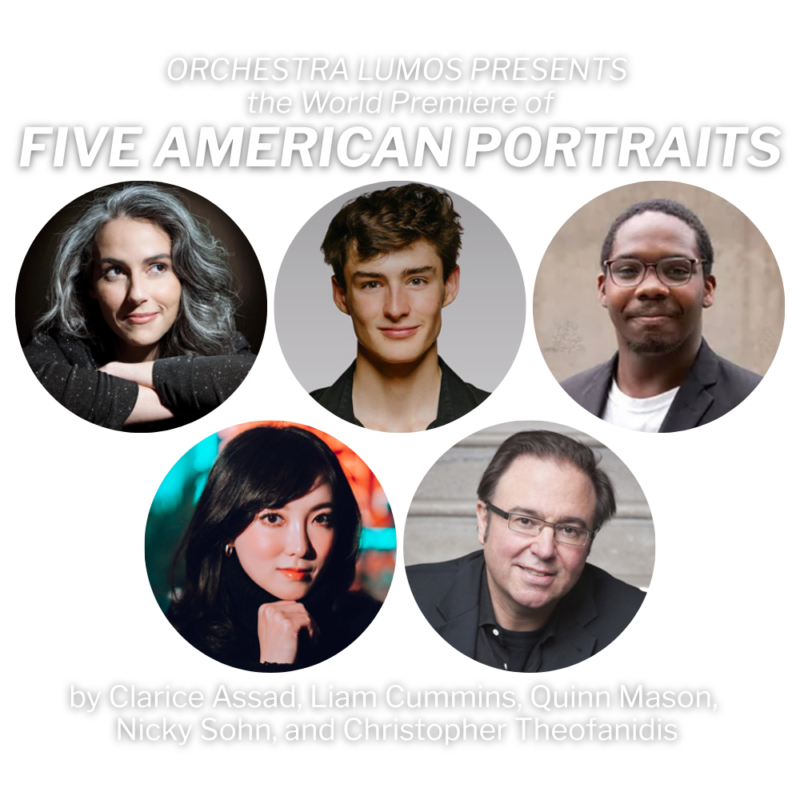
To mark America’s 250th birthday, Orchestra Lumos and Music Director Michael Stern will give the world premiere on April 18 and 19, 2026, of Five American Portraits, an exploration of individuals and phenomena that left an extraordinary and indelible mark on our nation.
The five American composers selected for the project are Clarice Assad, Liam Cummins, Quinn Mason, Nicky Sohn, and Christopher Theofanidis. Michael Stern asked each composer to write a short piece about a person or entity who, in their view, has influenced our country’s trajectory and contributed to the American story.
The commission is made possible by the Orchestra Lumos Commissioning Club, a consortium of more than a dozen donors who have been involved from the beginning of the project.
“The original premise of the piece was to commission a new work to commemorate our country’s 250th birthday. But our commissioning club quickly realized that it wouldn’t be as compelling to represent the breadth of America’s story with just one voice. That thought sparked the idea of inviting a range of composers — of different ages, backgrounds, and individual stories —to approach their part of the work from a personal perspective,” said Stern.
Stern continued, “I asked each composer to write about something or someone meaningful to them that had, in their view, contributed significantly to the narrative of our country. It was so interesting to me that not one of them selected what we might call ‘the usual suspects,’ such as traditional political or historical figures. What emerged through their lenses was a beautiful collection of portraits which reflects musically the ideal of E Pluribus Unum — the core value of our Great American Experiment.”
The five movements of Five American Portraits are:
I. Christopher Theofanidis: Rachel Carson–Scientist Poet
II. Nicky Sohn: Disney – Is this the Happiest Place on Earth?
III. Clarice Assad: Harry Houdini – The Illusionist
IV. Quinn Mason: Echoes of the Forgotten Americans
V. Liam Cummins: Howard Zinn – A People’s History
Composer Statements
Orchestra Lumos asked each of the Five American Portraits composers to tell us, in their own words, about the focus of their musical portrait and what compelled their choices.
- I. Christopher Theofanidis: Rachel Carson–Scientist Poet
- II. Nicky Sohn: Disney – Is this the Happiest Place on Earth?
- III. Clarice Assad: Harry Houdini – The Illusionist
- IV. Quinn Mason: Echoes of the Forgotten Americans
- V. Liam Cummins: Howard Zinn – A People’s History
Christopher Theofanidis
Movement I: Rachel Carson–Scientist Poet
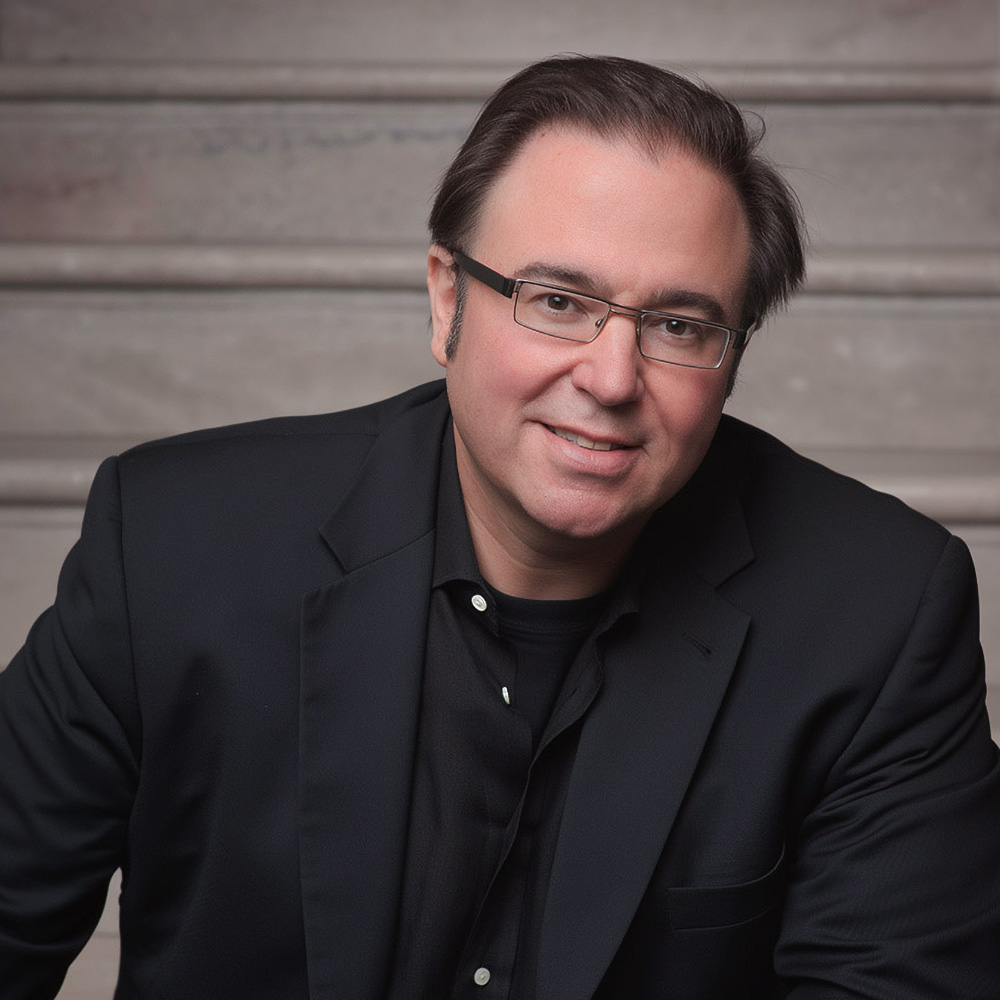
“It is interesting to me that Carson, an early 20th century marine biologist who, despite her science background, always retained a kind of poetry in her prose. Even when dealing with difficult subjects like the effects of DDT on the environment and the connection between pesticides and cancer in humans, her titles always belied a deep admiration for the beauty and wonder of nature and the natural world- with evocative titles like, Silent Spring, and The Sea Around Us, among others. This quiet, reverential movement is dedicated to her noble, inner calling of preserving beauty by taking action.”
Nicky Sohn
Movement II: Disney–Is this the Happiest Place on Earth?

Disney has become one of America’s most powerful cultural exports, shaping childhood imagination not only in the United States but across the world. Its films and songs offered generations of children a vision of wonder, innocence, and endless possibility — a dreamscape uniquely “American” in its optimism. In this movement, I draw on several of Disney’s most famous musical themes, presenting them in all their magical familiarity before gradually altering, distorting, and reframing them. What begins as enchantment becomes increasingly uncanny, revealing both the shine and the machinery of a global brand. In asking whether this is truly “the happiest place on earth,” the music becomes a portrait of America itself: at once inspiring and unsettling, mythic and manufactured.
Clarice Assad
Movement III: Harry Houdini – The Illusionist

Harry Houdini embodies the American dream. Born Erik Weisz in Hungary, this child immigrant reinvented himself as the world’s most celebrated escape artist, perfectly capturing America’s spirit of self-made success and boundless possibility. His death-defying escapes from handcuffs, straitjackets, and locked containers became powerful metaphors for breaking free from limitation— resonating deeply with audiences in an era of rapid social change and expanding freedoms. Beyond entertainment, Houdini pioneered modern celebrity through masterful use of newspapers and publicity stunts while simultaneously exposing fraudulent spiritualists who preyed on grieving families after World War I. His relentless pursuit of perfection, theatrical innovation, and fearless confrontation of danger reflected core American values: ingenuity, courage, and the audacious belief that the impossible could be made possible. Born March 24, 1874, and dying October 31, 1926—fittingly on Halloween—Houdini packed extraordinary achievement into 52 years, proving that anyone could transcend their circumstances through sheer force of will and imagination.
Quinn Mason
Movement IV: Echoes of the Forgotten Americans

This is a wide-ranging portrait not focusing on one specific person but to those who have a legacy and a contribution in the building of the United States that has otherwise been forgotten or lost to history. As for the specific people represented, it can have multiple meanings in multiple times in history; there are countless examples to focus on just one. Therefore, this aspect can have open meaning. As for the music, a timpani ostinato sounds as though they were distant funeral drums. The general mood is reflective and pastoral, more like a remembrance than an elegy. The spacing and feel of the harmony is open and can be compared to the early to mid American symphonic composition style, such as Roy Harris.
Liam Cummins
Movement V: Howard Zinn–A People’s History

Howard Zinn was an influential historian and author. He is best known for writing “A People’s History of the United States,” which challenges a nationalist, fundamentalist glorification of the country, instead exploring its complexity and the frequently uncomfortable truths of its past. “A People’s History” is often sobering, but Zinn views patriotism as distinct from government. He calls for patriotism “not as blind obedience to government, not as submissive worship to flags and anthems, but rather as love of one’s country, one’s fellow citizens (all over the world).” He calls for a patriotism that is loyal “to the principles of justice and democracy” rather than the government supposed to enforce those principles. He calls for patriotism that challenges government, that protests violence, that holds human rights over military power. “Should we not begin to redefine patriotism?” he asks. Inspired by these words, this piece sets up two distinct worlds – one of Zinn’s true, quieter, inner envisioning of the American spirit, and one set to cover it up with brasher, less sincere music. The piece, thus, honors the great historian, his sense of patriotism, and the country to which he dedicated his life’s research. I can’t think of a more fitting – or more sincere – way to honor this country while recognizing the realities of such a fraught time.