

America 250
Saturday, April 18, 2026 at 7:30pm
Sunday, April 19, 2026 at 3:00pm
America 250
Saturday, April 18, 2026 at 7:30pm
Sunday, April 19, 2026 at 3:00pm
America 250
Saturday, April 18, 2026 at 7:30pm
Sunday, April 19, 2026 at 3:00pm
The Palace Series
Experience the thrill of a live, full orchestra
Location
The Palace Theatre
61 Atlantic Street, Stamford, CT 06901
Duration
2 hours with a 20
minute intermission
Share With
About this performance
Our American birthday party really goes on the town with Leonard Bernstein’s helluva Three Dance Episodes from On the Town! Add in George Gershwin’s Rhapsody in Blue and Aaron Copland’s Appalachian Spring and the gang’s all here. But wait, there’s more: Orchestra Lumos has commissioned no less than five composers to write a new suite Five American Portraits. Join us for this concert of celebration!
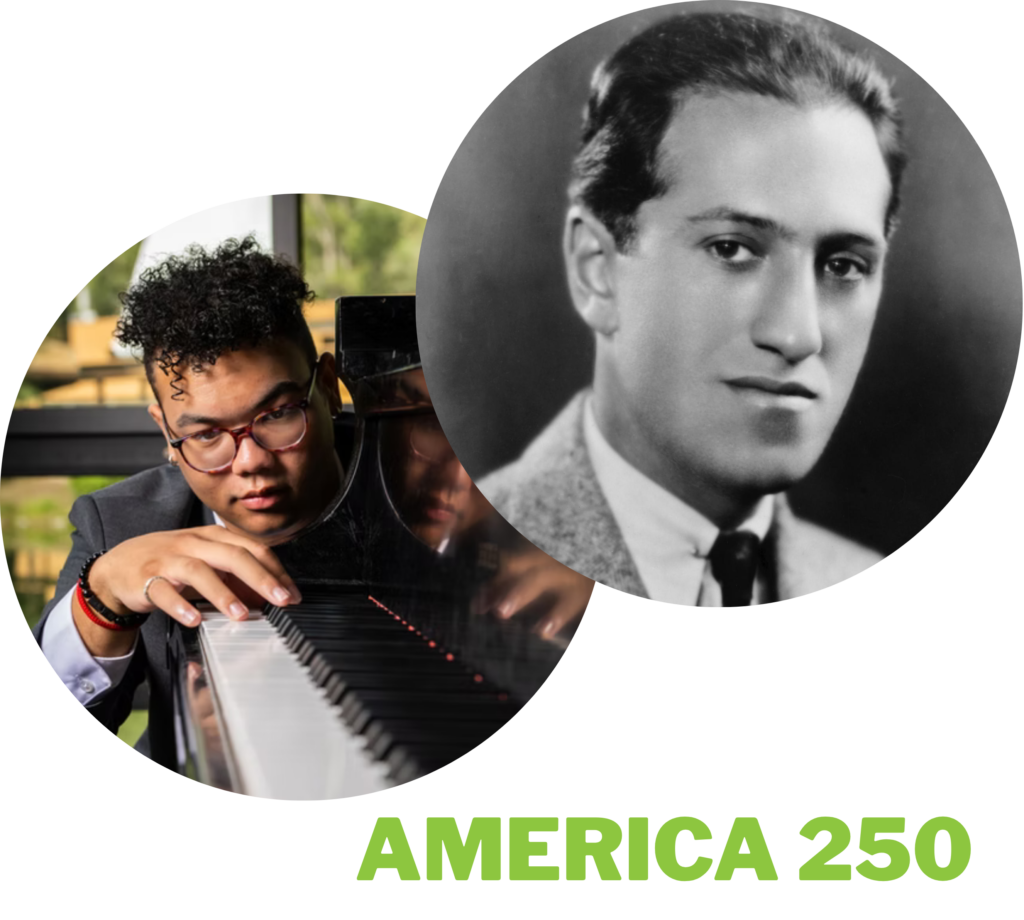
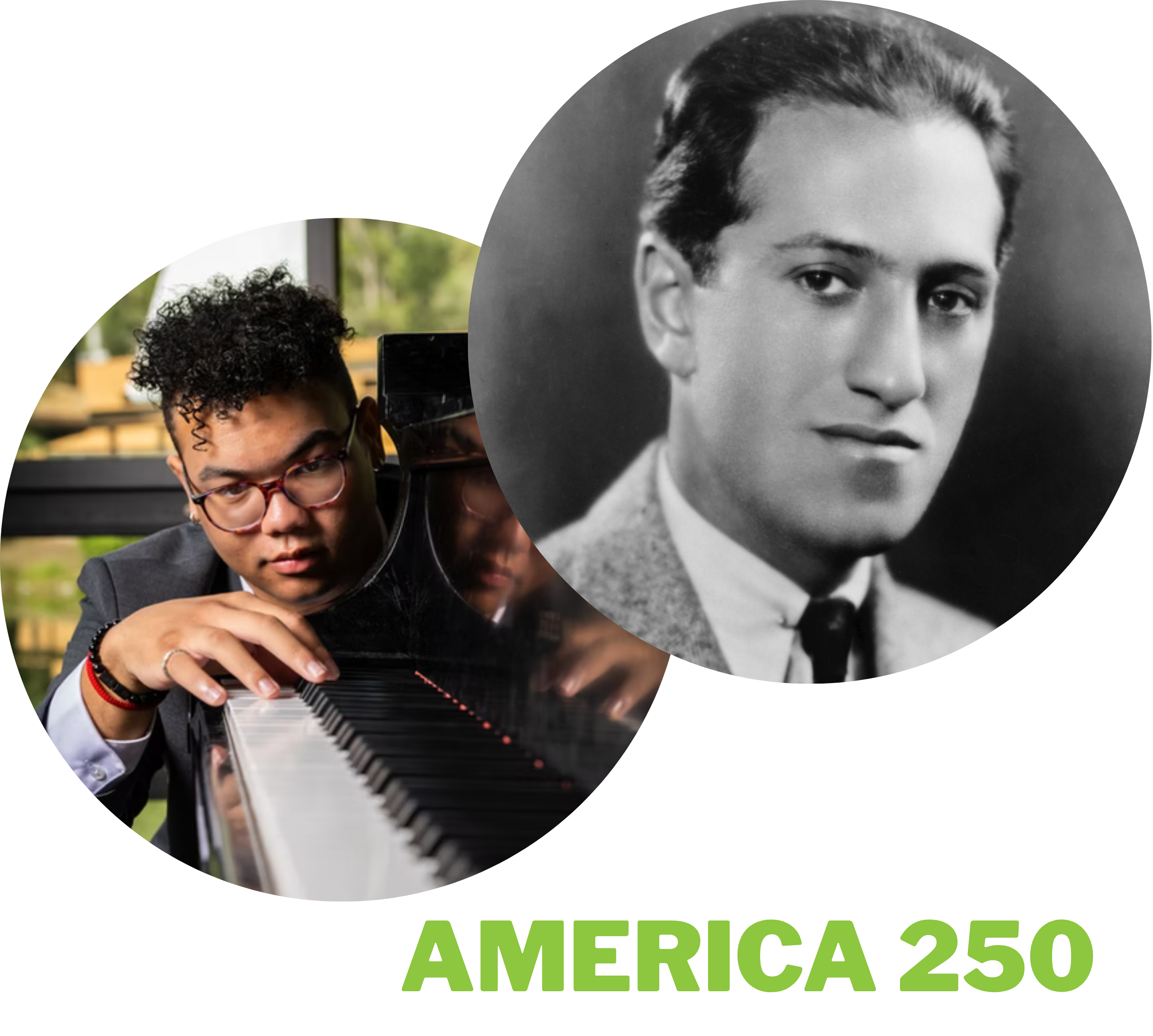
Joshua Mhoon, piano
The Stern Young Artist 2025/26
Michael Stern, conductor
Full Orchestra
This concert is dedicated with deep affection to the memory of Louise B. Stern who was a champion and friend of Orchestra Lumos for many years.
Support for this program has been provided by The Soroca Fund for American Music.
This project is supported in part by the National Endowment for the Arts.
Musical Program to include
Leonard Bernstein Three Dance Episodes from On the Town
Orchestra Lumos Commission Five American Portraits
World Premiere commissioned by five American composers:
Clarice Assad
Liam Cummins
Quinn Mason
Nicky Sohn
Christopher Theofanidis
Aaron Copland Appalachian Spring Suite
George Gershwin Rhapsody in Blue
Five American Portraits, Orchestra Lumos Commission
Five American Portraits was commissioned by Orchestra Lumos around a new creative idea.
Five participating composers will bring their unique talents, individual perspectives, and experiences to write a musical portrait of one person who, in their view, helped shape America into what it is today and contributed to the ongoing American story. This collaboration is noteworthy not only for the participation of these five outstanding composers but also because their contributions will be integrated to create a new work greater than the sum of its parts.
Composer selections:
• Christopher Theofanidis – Movement I: Rachel Carson–Scientist Poet
• Nicky Sohn – Movement II: Disney–Is this the Happiest Place on Earth?
• Clarice Assad – Movement III: Harry Houdini – The Illusionist
• Quinn Mason – Movement IV: Echoes of the Forgotten Americans
• Liam Cummins – Movement V: Howard Zinn–A People’s History
Orchestra Lumos Commissioning Club
Five American Portraits was made possible by the generosity of the following individuals who comprised the Orchestra Lumos Commissioning Club 2025/26. Orchestra Lumos is deeply grateful for their vision, participation and support.
Jane and Stephen Alpert
Mimi Cohen
Aaron Gillies and Russell Jones
Stefania DiGiuseppe and John Charles Jove
Maria and Alan McIntyre
Diane and Steve Parrish
Barbara Scheulen and Edward Stanford
Michael Stern
Betsy and Michael Stone
Norma* and Donald* Stone
Lisa and Paul Welch
*deceased
Your Orchestra Lumos Experience
Join Us for illuminating discussions hosted before and after concerts
Behind the Baton: Held in the upstairs lobby of the Palace Theater 30 minutes prior to each concert
Learn more about the program with Music Director Michael Stern. This pre-concert talk
offers a deeper look into the music and introduces you to the soloist and hosts.
After Hours: Held in the lower lobby café following Saturday evening concerts
Michael Stern moderates an interactive discussion after the concert with a panel of guests (musicians, composers,
and hosts). Join us for a glass of wine and feel free to ask questions and share your own thoughts!
Sharing the Joy of Music with Young Audiences
Orchestra Lumos is broadening access to, and appreciation of, musical experiences for young audiences. Children aged 5-17 come FREE* with an accompanying adult for the Sunday afternoon concert. (* $4 facility fee is applied to all tickets ordered.)
Featured Artists
Joshua Mhoon, piano

American pianist, Joshua Mhoon’s talent for piano was discovered at the age of 7. Quickly dedicating himself to the instrument, he advanced at an exponential rate, despite his comparatively late introduction to music. His quick progression landed him first place prizes in The DePaul National Concerto Competition, The Walgreens National Concerto Competition’s Senior and Junior divisions, The Emilio del Rosario Concerto competition, and accomplishments such as TV appearances on The Tamron Hall Show, NBC Chicago, CBS Chicago, Redbull TV, WTTW’s Chicago tonight, The Mozart on TV Asahi in Japan, along with a feature in the Emmy award winning episode of Built to Last on PBS. Mhoon has given live performances for worldwide audiences in Japan, England, France, Greece, Turkey, Austria, Spain and Italy, and several concert tours in Germany. In 2023, after being named the Silver Medalist at the inaugural Nina Simone Piano Competition, Mhoon catapulted to new heights in the classical music industry, with engagements domestically, and abroad for the 2024-25 season.
Mhoon’s upbringing in Chicago, shaped his musical vision, growing up in the culture of Black American Music, such as R&B, jazz, blues, hip hop, and gospel. Mhoon has had various opportunities to showcase his abilities locally in Chicago, demonstrating a sense of pride in his hometown. Mhoon had the privilege of performing at Chicago Mayor Lori Lightfoot’s inauguration, a historic event that gained thousands of viewers on television and live attendance at the city’s Wintrust Arena. Additionally, his other performances in his city include a halftime show at a Chicago Bulls game, a performance for Chicago Mayor Rahm Emanuel and China’s Vice Premier at the Harris theater; performances at the Navy Pier, Ganz Hall, The Studebaker Theater, Pritzker Pavilion, Pianoforte, and Bennett Gordon Hall at the Ravinia Festival. His radio performances became extremely popular as he played and spoke of his love of piano on popular radio shows including the Cliff Kelly Show on WVON with its mostly African American audience. As well as his popularity with larger ethnically diverse audiences appearing in multiple episodes on Chicago’s classical music station WFMT as well as Richard Steele’s program on Chicago National Public Radio’s WBEZ. Other Radio Appearances and performances have been heard on NPR’s From the Top as well as New York’s Classical Music Radio Station WQXR.
At the age of 15, Mhoon began studying at Northwestern University’s Bienen School of Music with the school’s renowned Director of Musical Performance, Dr. James Giles. Outside of classical music, Mhoon has also studied jazz and spontaneous creation/composition with jazz legends Willie Pickens and Steve Million. He previously studied jazz with Miles Davis’s former music director Bobby Irving III. Mhoon is also mentored by world-renowned pianist Lang Lang and principal clarinetist of the New York Philharmonic Anthony McGill. Recent and upcoming highlights of Mhoon’s career include performances with the Cincinnati Symphony under musical director Louis Langrée, Yo-Yo Ma, Lang Lang, Anthony McGill, and Gil Shaham at an impressive number of venues, including the Jazz at Lincoln Center, Weill Recital Hall, and the world famous Stern Hall of Carnegie Hall, Steinway Hall, Chicago Symphony Hall, Alice Tully Hall, New World Symphony Center, Chicago Symphony Center, and the Musikverein.
He hopes to foster an appreciation of classical music to reach a larger demographic of people. Mhoon is currently studying in New York City at the Juilliard School under the tutelage of world-renowned pianist Emanuel Ax and Julian Martin. Although he has pursued a few other hobbies, including photography, practicing yoga, and investing in the stock market, above all else, Mhoon loves listening, playing, and composing music. As he said in a 2016 interview with WTTW, “I definitely want to make music my life.” Now, it is clear that Joshua Mhoon is doing exactly that.
Mhoon is a Young Steinway Artist.
Photo credit: Diego Redel
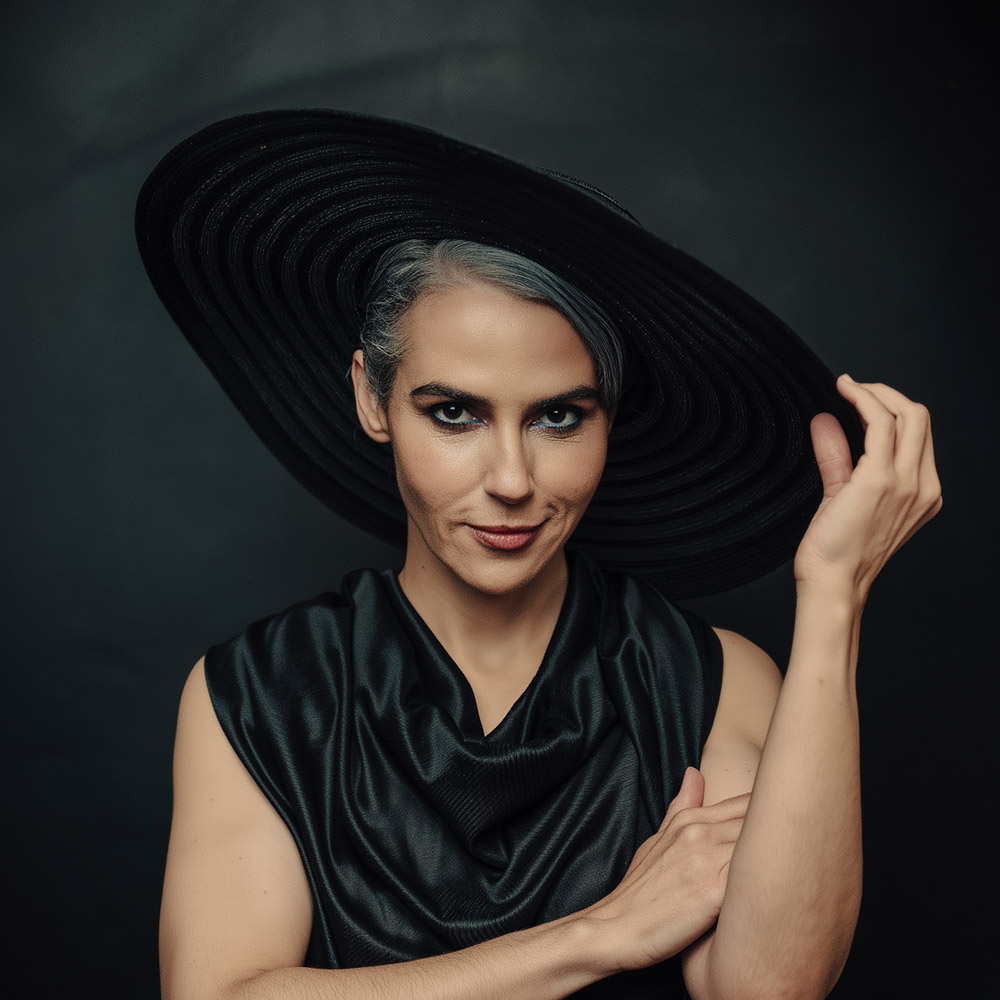
Clarice Assad, composer
“She energetically bends music to her will and reshapes it with fascinating results.”
–Jazz Improv Magazine
A powerful communicator renowned for her musical scope and versatility, Brazilian-American Clarice Assad is a significant artistic voice in the classical, world music, pop, and jazz genres. The Grammy Award–nominated composer, celebrated pianist, inventive vocalist and educator is acclaimed for her evocative colors, rich textures, and diverse stylistic range.
What motivates Assad? What drives her passion and creativity? Writing and playing music that inspires and encourages audiences’ imaginations to break free of often self-imposed constraints is just the beginning. She endeavors to harness the incredible and intangible power of music to connect people and transform lives through original works, commissions, and education programs that give voice to everything from the impact of climate change to issues of social justice, gender equity, and the empowerment of young voices.
With her talent sought-after by artists and organizations worldwide, the polyglot musician continues to attract new audiences both onstage and off. In the recording arena, Assad has released seven solo albums and appeared on or had her works performed on another 34. Her music is represented on Cedille Records, SONY Masterworks, Nonesuch, Adventure Music, Edge, Telarc, NSS Music, GHA, and CHANDOS. Her innovative and award-winning VOXploration education series on music creation, songwriting, and improvisation has been presented throughout the world.
The prolific composer has more than 70 works to her credit, including numerous commissions for Carnegie Hall, the Chamber Music Society of Lincoln Center, the Boston Youth Orchestra, Chicago Sinfonietta, San Jose Chamber Orchestra, the Bravo! Vail Music Festival, and the La Jolla Music Festival, to name a few. Her compositions have been recorded by some of the most prominent names in classical music, including percussionist Dame Evelyn Glennie, cellist Yo-Yo Ma, violinist Nadja Salerno-Sonnenberg, and oboist Liang Wang. Assad’s music has been performed by the Philadelphia Orchestra, Tokyo Symphony, Queensland Symphony, and the Orquestra Sinfônica de São Paulo. She has served as a composer-in-residence for the Albany Symphony, the Cabrillo Festival of Contemporary Music, New Century Chamber Orchestra, and the Boston Landmarks Orchestra. Her works are published in France (Editions Lemoine), Germany (Trekel), Brazil (Criadores do Brasil), and in the U.S. by Virtual Artists Collective Publishing (VACP), a publishing company she co-founded with poet and philosopher Steve Schroeder. Assad recently wrote the soundtrack to Devoti Tutti, a documentary by Bernadette Wegenstein, and is composing the music for a ballet by award-winning choreographer Shannon Alvis.
As a performer, Assad has shared the stage with Bobby McFerrin, Anat Cohen, Nadia Sirota, Paquito D’Rivera, Tom Harrell, Marilyn Mazur and Mike Marshall, among others. She has performed at internationally renowned venues and festivals including The Netherlands’ Concertgebouw, Carnegie Hall, Belgium’s Le Palais des Beaux-Arts, Le Casino de Paris, Jazz at Lincoln Center, and the Caramoor International Jazz Festival.
Assad also strives to expand the sonic palette of the voice, including immersing audiences in the music as active participants and by electronically altering sounds, “like one of those cooks who can turn any four random foodstuffs into a feast” (Classical Voice North America).
She takes the immersive experience outside of the concert hall with the innovative and accessible VOXploration, which she created in 2015. The program offers a creative and fun approach to music education through meaningful, interactive experiences. It has been carefully curated to work equally well with participants of any age or musical background. It has received numerous grants and awards from Brazilian foundations such as CAIXA CULTURAL and SESC, as well as American organizations New Music USA and the McKnight Foundation. Assad has given master classes, residencies, and workshops throughout the United States, Europe, and the Middle East.
Born in Rio de Janeiro, Clarice Assad is one of the most widely performed Brazilian concert music composers of her generation. The recipient of numerous honors and awards, amongst them an Aaron Copland Award and several ASCAP awards in composition, she holds a Bachelor of Music degree from the Roosevelt University in Chicago, and a Master of Music degree from The University of Michigan School of Music.
Liam Cummins, composer
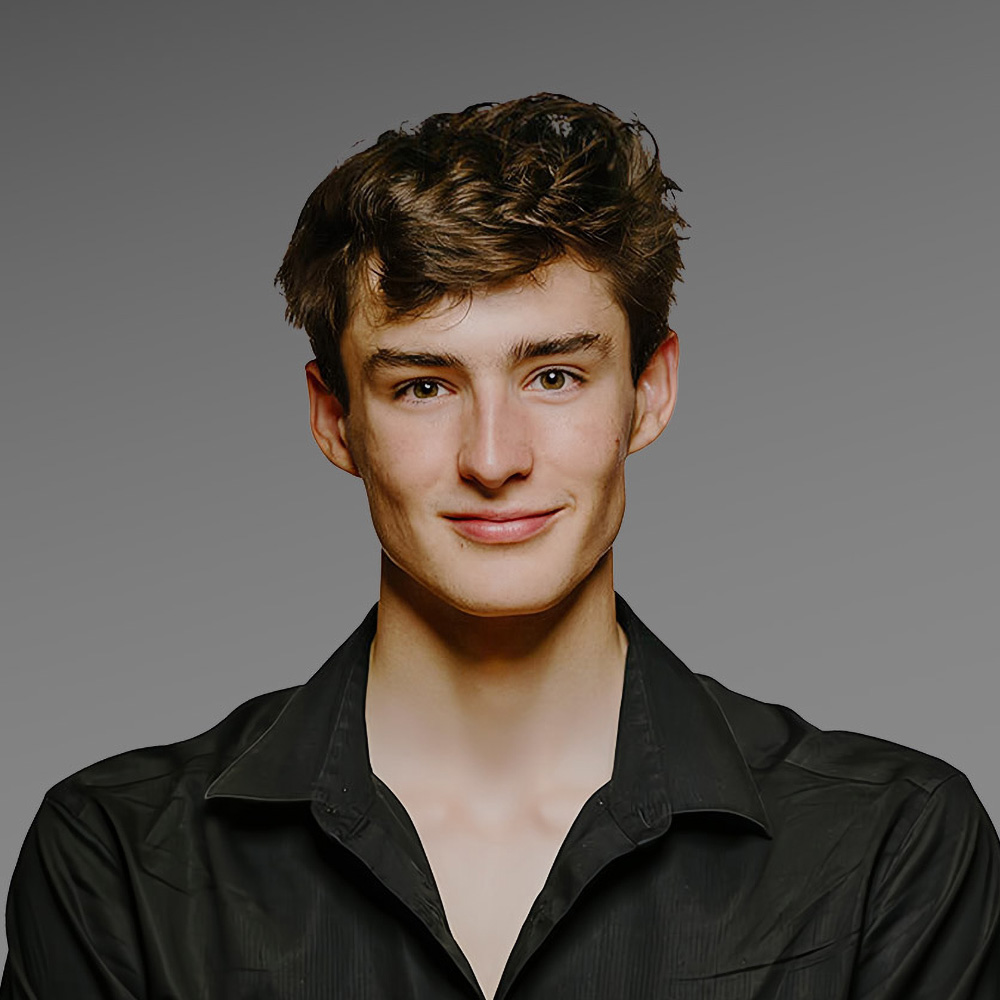
Liam Cummins (b. 2004) writes music that builds bridges, bringing wide-ranging ideas and people together. His compositions span the extremes of grand gesture and subtle nuance, vibrant lyricism and bitter dissonance, high drama and piercing simplicity. Knitting together diverse materials and sound-worlds, he seeks new windows into age-old traditions.
His music has been widely recognized for its incisive craft and emotional sensitivity. He has received recent commissions from Orchestra of St. Luke’s, New York Youth Symphony, Orchestra Lumos, The Juilliard School’s AXIOM, and Aspen Contemporary Ensemble, among other orchestras, ensembles and soloists across the United States and beyond. He is a recipient of a 2024 Charles Ives Scholarship from the American Academy of Arts and Letters, a 2023 ASCAP Morton Gould Award, and the 2022 YoungArts Gold award in Classical Music. His music has also been recognized by Tribeca New Music, Orchestra of St. Luke’s, New York Youth Symphony, American Composers Orchestra, National Young Composers Challenge, The Silent Voices Project, Juilliard’s AXIOM competition, the New England Philharmonic, Icarus Quartet and NPR’s The American Sound. In 2022, he was the only young composer in the country nominated for consideration as a United States Presidential Scholar in the Arts. His music has premiered at Alice Tully Hall, The Kennedy Center for the Performing Arts, Aspen Music Festival, Carnegie Hall’s Stern Auditorium and numerous other venues throughout around the world.
Liam is pursuing a Bachelor of Music degree in composition at The Juilliard School, studying with John Corigliano. He has been awarded fellowships at Aspen Music Festival, National YoungArts Week and the DeGaetano Composition Institute, and has participated in festivals including Curtis Institute of Music’s Young Artist Summer Program, Yellow Barn’s Young Artist Program, The Walden School, the Cleveland Institute of Music’s Young Composers Program. Through these opportunities he has studied with luminaries including Augusta Read Thomas, Christopher Theofanidis, Kevin Puts, Martin Bresnick, David Ludwig, Pierre Jalbert, Reiko Füting, Melinda Wagner, George Tsontakis, Zhou Long, Nico Muhly, Ana Sokolovic, Eric Nathan, Pascal Le Boeuf and Chen Yi.
Liam is an avid backpacker and adventurer. When not making music, you’ll likely find him in the natural world, camera and notebook in hand, seeking adventure at every opportunity. In turn, these experiences deepen and enrich his musical passion.
Quinn Mason, composer
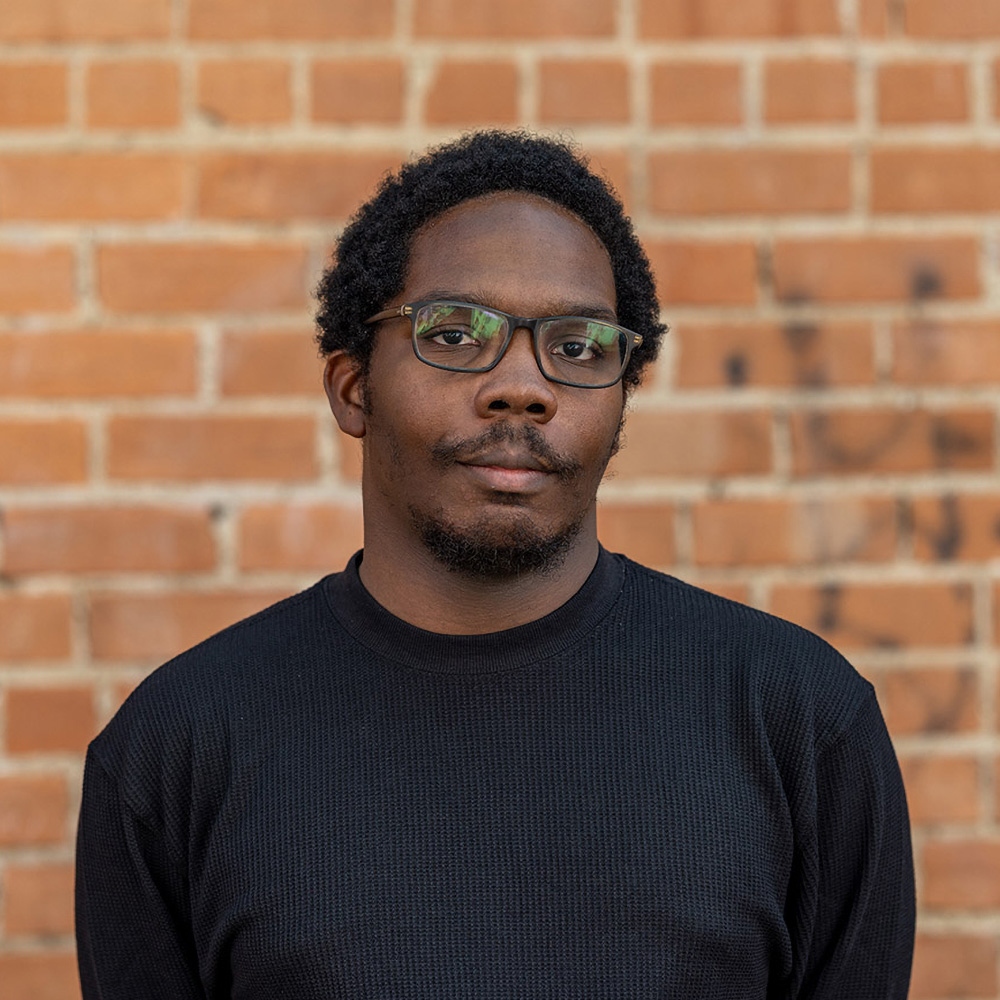
Praised as “One of the most sought after young composers in the country” (Texas Monthly) and “a composer who clearly understands the orchestra and knows how to take advantage of its many varied colors” (Tallahassee Democrat), composer and conductor Quinn Mason (b. 1996) has distinguished himself as an artist of national and international renown. Winner of the 2025 ASCAP Morton Gould Young Composer award and one of the most performed composers of his generation, his orchestral music has been commissioned and performed by over 220 orchestras in the US and Europe, including by the San Francisco, Seattle, Detroit, Cincinnati, Dallas, Utah, Phoenix, and Kansas City symphonies, Minnesota Orchestra, Rochester Philharmonic and National Youth Orchestra of the United States (NYO-USA), Ensemble Obiora (Canada) and in Europe by the Orchestra Sinfonica Nazionale della RAI, Sheffield Philharmonic Orchestra, West of Scotland Schools Symphony Orchestra plus many more.
Equally renowned as an international conductor, Quinn was selected by musicians of the Atlanta Symphony Orchestra as the winner of the Emerging Maestros Conducting Competition in 2025, and made successful debuts with the Berliner Symphoniker (Germany), Orchestra Filarmonica di Firenze (Italy), North Czech Philharmonic and West Bohemian Symphony Orchestra (Czech Republic) and Siamo Orkest (The Netherlands). In 2026, he will conduct the Vratsa Symphony Orchestra (Bulgaria) and Albanian Radio and Television Symphony Orchestra.
He has studied with Jorma Panula, Esa-Pekka Salonen, Jukka-Pekka Saraste, Marin Alsop, Robert Spano, Gerard Schwarz, Arturo Tamayo, György Györiványi Ráth, Tomáš Koutník, Michael Palmer, Scott Seaton and Carl Topilow and has guest conducted over 40 orchestras around the world, including the National Symphony Orchestra, Houston Ballet Orchestra, Hartford Symphony Orchestra, Denver Philharmonic Orchestra and West Virginia Symphony Orchestra. Quinn has studied closely with renowned composers David Maslanka, Jake Heggie, Christopher Theofanidis, Jimmy Lopez Bellido, Libby Larsen, David Dzubay and Robert X. Rodriguez.
Nicky Sohn, composer

Selected as one of the “Cool 100” by Houston CityBook Magazine alongside icons such as Simone Biles and Megan Thee Stallion, composer Nicky Sohn is a versatile and sought after voice in contemporary classical music. With a distinctive style characterized by jazz inspired, rhythmically driven themes, her work has been praised internationally as “undoubtedly the crowd pleaser of the evening” (YourObserver), “dynamic and full of vitality” (The Korea Defense Daily), showcasing “colorful orchestration” (NewsBrite), and evoking “elegant wonder” (Frankfurter Allgemeine Zeitung).
Recent highlights include the premiere of Sohn’s guitar concerto with the Albany Symphony featuring guitarist Bokyung Byun, followed by a sinfonietta performance at the 2025 Tanglewood Music Festival. She also composed a large scale ballet for BalletCollective, premiered at the Cathedral of St. John the Divine in New York City in collaboration with choreographer Alysa Pires and visual artist Linn Meyers. Additional projects include a cello concerto commissioned by the University of Iowa and recorded by the Czech Chamber Philharmonic Orchestra, and Galaxy Back to You for the Balourdet Quartet, commissioned following their Avery Fisher Career Grant win and featured on their debut CD.
Sohn has a busy spring ahead with three orchestral premieres by the Atlanta Symphony, Knoxville Symphony, and Orchestra Lumos, and is currently composing a new orchestral work for the Amarillo Symphony for their 2026–27 season.
Christopher Theofanidis, composer
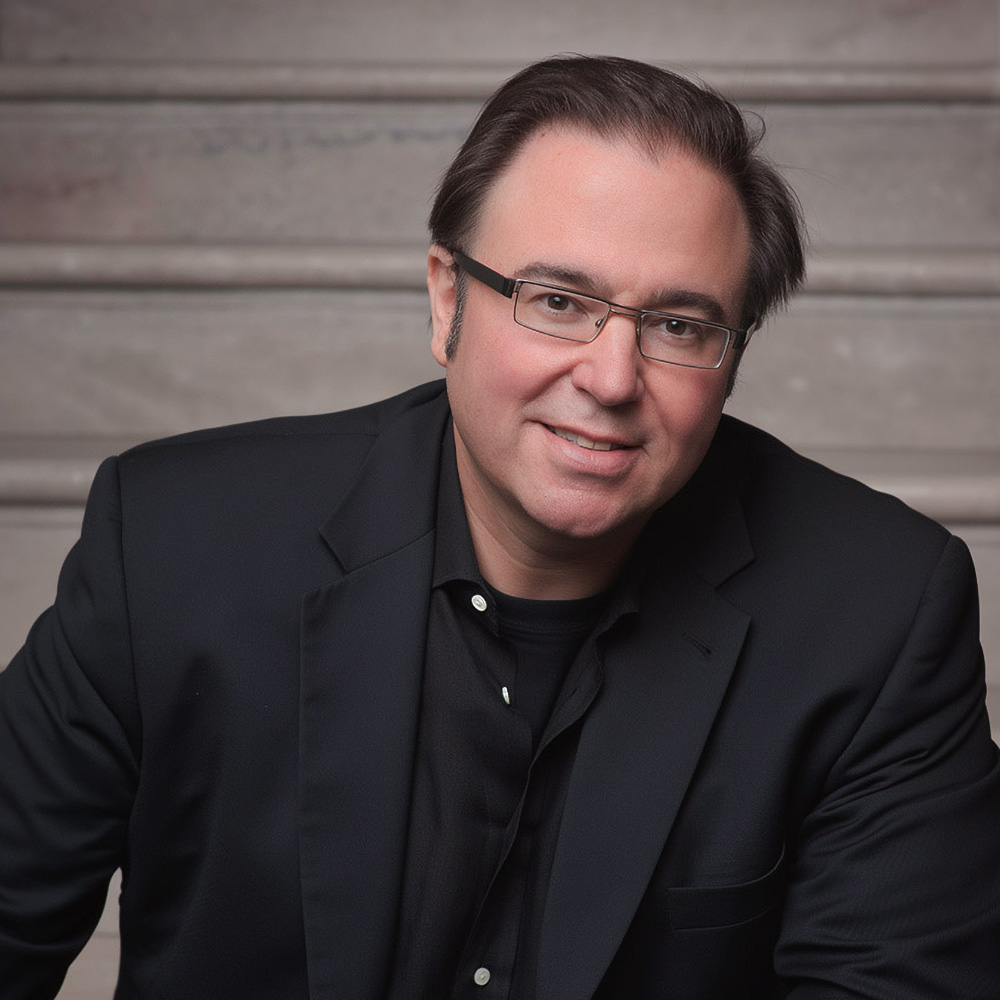
Christopher Theofanidis (b. 12/18/67 in Dallas, Texas) has had performances by many leading orchestras from around the world, including the London Symphony, the New York Philharmonic, the Philadelphia Orchestra, the Atlanta Symphony, the Moscow Soloists, the National, Baltimore, St. Louis, and Detroit Symphonies, among many others. He has also served as Composer of the Year for the Pittsburgh Symphony during their 2006-7 season, for which he wrote a violin concerto for Sarah Chang.
Mr. Theofanidis holds degrees from Yale, the Eastman School of Music, and the University of Houston, and has been the recipient of the International Masterprize, the Rome Prize, a Guggenheim fellowship, a Fulbright fellowship to France to study with Tristan Mural at IRCAM, a Tanglewood fellowship, and two fellowships from the American Academy of Arts and Letters. In 2007 he was nominated for a Grammy award for best composition for his chorus and orchestra work, The Here and Now, based on the poetry of Rumi, and in 2017 for his bassoon concerto. His orchestral work, Rainbow Body, has been one of the most performed new orchestral works of the new millennium, having been performed by over 150 orchestras internationally.
Mr. Theofanidis’ has written a ballet for the American Ballet Theatre, a work for the Orpheus Chamber Orchestra as part of their ‘New Brandenburg’ series, and two operas for the San Francisco and Houston Grand Opera companies. Thomas Hampson sang the lead role in the San Francisco opera. His work for Houston, The Refuge, featurs six sets of international non-Western musicians alongside the opera musicians. He has a long-standing relationship with the Atlanta Symphony and Maestro Robert Spano, and has just four recordings with them, including his concert length oratorio, Creation/Creator, which was featured at the SHIFT festival at the Kennedy Center in Washington, D.C. this year with the ASO, chorus, and soloists. His work, Dreamtime Ancestors, for the orchestral consortium, New Music for America, has been played by over fifty orchestras over the past two seasons. He has served as a delegate to the US-Japan Foundation’s Leadership Program, and he is a former faculty member of the Peabody Conservatory of Johns Hopkins University as well as the Juilliard School. Mr. Theofanidis is currently a professor at Yale University, and composer-in-residence and co-director of the composition program at the Aspen Music Festival.
Program Notes
Three Dance Episodes From on the Town
Leonard Bernstein
Almost twenty years after Leonard Bernstein’s death, the critics are still arguing over the meaning and impact of his legacy. What is clear, however, is that the world rarely enjoys the genius of someone who excels supremely in so many artistic endeavors. Pianist, conductor, television personality, teacher, mentor, social gadfly, and composer of both popular musical theatre and “serious works,” Bernstein wore all hats with avidity. And he enjoyed stunning success in most. He had a passion about everything that he essayed, whether conducting the Mahler that he loved so well, or in his many teaching roles, helping audiences “peel” apart the mysteries of music. He knew so much, and could do so much, that he genuinely thought that he could do it all. His leadership of the New York Philharmonic Orchestra and other orchestras is legendary, but everyone knows there were some concerts that, frankly, got away from him in his self-indulgence. He worked assiduously as a composer of “serious” music, but those works—from youthful successes to his late efforts–have enjoyed only mixed success. All that says is simply that he was human. Other than his epochal conducting, there is one field in which he garnered almost universal acclaim, and that is musical theatre. When all is said and done, he possessed a talent and a facility for the stage that was as deep as it was prolific. He understood the genre and its demands well.
He plunged in early, writing for student productions at Harvard, and working with a cabaret group (that included Judy Holiday) while a student at the Curtis Institute. When he was twenty-six, his ballet Fancy Free was first performed at the Metropolitan Opera and On the Town opened on Broadway. Wonderful Town, Peter Pan, Facsimile, Candide, and, of course, West Side Story, followed in succession. But, the music that Bernstein provided for Fancy Free was the beginning. The ballet is by the giant of choreography, Jerome Robbins, and went on to be reincarnated that same year (1944) as the Broadway musical On the Town. The Broadway show subsequently was made into a film in 1949; however, most of Bernstein’s music was thrown out by Hollywood as too “complex and operatic.” Those who have seen the show in any of its versions will easily remember the simple premise of the plot: three sailors on liberty in New York City, looking for female companionship, engage in a series of ritual dances of courtship, competing for the affections of the girls, all the while romping through the remarkably diverse cityscape of the “Big Apple.”
Bernstein extracted the three subject dances from the musical, and the concert piece was given its première by the San Francisco Symphony early in 1946. Taken together, the three dances are a marvelous period piece of New York urban musical culture circa 1944. The young Bernstein, totally smitten with the energy of his adopted city—especially the swing, blues, and bebop jazz of the time—put it all into the show. Stir into this a completely obvious and conscious adoption of the musical style of the young Bernstein’s musical idol and mentor, Aaron Copland, and you have accounted for most of what you hear. All cities constantly change, and there’s not a lot of the present New York City of today in On the Town—of course. Jazz has changed and not many composers write like Copland, today, but it’s all well done, and infectiously appealing. Upon the occasion of its revival in 1971, the drama critic of the New York Times snarkily wrote: “The music…has worn less well, too many of the nostalgic ballads sound like sub-Puccini filtered through Glenn Miller.” But, never mind. It’s New York! It’s Leonard Bernstein! And memorably, it’s “New York, New York, it’s a helluva town!”
The first dance, “The Great Lover,” is the Act I scene with our hero, the sailor, Gabey, early in the day (the whole show is set in a single day) asleep on a subway car, after having seen a poster of the beauty queen of the rails, “Miss Turnstile,” and dreaming of wooing her. The punchy, dissonant accents over a jazzy, frantic tempo perfectly depict the sleepy sailor valiantly trying to get forty winks on the lurching, noisy New York subway. A variety of short, melodic “licks” punctuate the relentless tempo. Some are jazzy, and some are just plain banal—all reflective of the kaleidoscopic thoughts of the sailor. And, of course, throughout, the familiar metrical displacements and accents of Copland inform the young composer’s score. Each of the dances is dedicated to someone from the production, and the first dance is dedicated to none other than the ballerina, Sono Osata, who was “Miss Turnstiles.”
The second dance, “Lonely Town,” is a short little pas de deux between a worldly sailor and a young high-school girl encountered Central Park. While surely occurring in the daytime, it has an almost nocturnal, melancholic mood. In Bernstein’s words: it’s “both tender and sinister” as the sailor woos her, and then callously casts her off. It adroitly evokes the almost desperate, hopelessness under the circumstances of the two souls having anything but a fleeting relationship. It is dedicated to one of the immortals of American musical theatre, Betty Comden, who wrote the show, along with Bernstein, and her long-term professional partner, Adolf Green. And—while Bernstein wrote the great tune in the dance, any informed music lover who was unfamiliar with the show, would understandably think it was composed by Aaron Copland, so perfect is the evocation of the latter’s musical style.
The last dance is dedicated to the great Nancy Walker, a member of the original cast—you know her from a thousand appearances on fifties and sixties TV, not to mention her indelible performance as the waitress in the Bounty paper towel commercials. It’s called “Times Square Ballet,” and a better depiction of that mad, tourist-crammed, light show cannot be imagined. Our sailors meet to embark on a night on the town, go to the famous Roseland Dance Palace, and, well—do what sailors do. Opening with a jazzy, solo clarinet, the dance quickly segues to the evergreen, “New York, New York,” and after a slow down and a rhythmic change to swing time, a solo saxophone contributes its own transformation of the famous tune. Anything goes in the city, and apparently anything goes in the music, too, so, we hear a rather stylized rendition of what seems to be a chicken-clucking fiddle tune, in the best vaudeville style. A growling trumpet leads to what appears to be the aftermath of a bit too much to drink, followed by a crashing, rhythmically-layered conclusion, in the best Bernstein style. Not a bad way to start a fantastic career.
Program notes by:
Wm. E. Runyan
©2016 William E. Runyan
Appalachian Spring: Concert Suite for Full Orchestra
Aaron Copland
Aaron Copland is generally considered America’s greatest composer. That is, it is he, through his compositions and through his essays, books, lectures, and other thoughts on music who has done more than any other individual to establish a corpus of “serious” music in this country that largely defined an “American Sound.” He lived a long life; influenced generations of young composers; advanced the cause of art music in this country; and composed music that delighted millions in the audiences of ballet, chamber music, symphonic music, radio, television, and the movies. The son of Jewish immigrants, he lived for most of his life in New York City—or close by—but assimilated so much of the disparate elements of our culture that he came to be considered as representative of all of it. In his music one finds jazz, ethnic, western, folk, intellectual, and populist elements and references—and much more: Cuban, Mexican, and European Continental. But his wide-ranging intellect easily synthesized it all into an inimitable style (or small group of stylistic voices) with which his music spoke with a clear and unified expression.
His greatest musical influence was undoubtedly the grande dame of teachers, Mme. Nadia Boulanger, with whom he studied in Paris during the early 1920s. Teacher of generations of distinguished performers and composers, she counted Copland as her greatest pupil. Of course, while spending those years in Paris—along with the so-called “lost” generation (Copland was assuredly not part of it)—he was exposed to a wealth of musical styles and composers. Of them, Stravinsky was the other great influence upon Copland. Upon his return to the USA his early dalliances with jazz and “symphonic jazz” were more or less replaced by a severe, often dissonant style—one not often associated with Copland by many of today’s audiences, but definitely a life-long option for him in his compositions. During the 1930s his interest in socialist perspectives crystallized for him and he turned to a more accessible, populist style that has come to be his hallmark for mainstream America. His ballets, Billy the Kid, Rodeo, and Appalachian Spring, as well as his music for the films, Of Mice and Men and Our Town and other works all endeared him to a wide audience and made his reputation as a composer of “American” music. He continued that trend with the Lincoln Portrait, music for the film adaptation of Steinbeck’s Red Pony, and even wrote a clarinet concerto for the great Benny Goodman. How mainstream American can you get? But about 1950 both Copland’s musical style and his popular place in society took a distinct turn. His earlier support of socialist causes (he supported the American Communist Party in the election of 1936) made him a target of Red Hysteria and Senator McCarthy. The Republican Party cancelled a performance of his Lincoln Portrait for Ike’s inauguration, and other indignities followed him for a few years. His music began—but not completely—to return to the severe and dissonant basis that informed his early work, and he occasionally disappointed those who commissioned works thinking they were going to get another Appalachian Spring. By 1972, in his own words, it was “as if someone had simply turned off a faucet,” and he gave up composition completely. He died in 1990 of Alzheimer’s disease.
In 1943 the great American dancer and choreographer, Martha Graham, armed with $500 from a prominent patron, approached Copland with the idea to write some music for her ballet company. He had already garnered success with Billy the Kid, and Rodeo—Copland was a lifelong aficionado of dance—and soon produced a half-hour or so of music appropriate to a story quite unlike that with which we now are familiar. He simply entitled the work, “Music for Martha.” Dissatisfied with the original story, Graham completely reworked it into a scenario (following the published score) that concerns a pioneer celebration:
“… in spring around a newly-build farmhouse in the Pennsylvania hills in the early part of the last century. The bride-to-be and the young farmer-husband enact the emotions, joyful and apprehensive, their new domestic partnership invites. An older neighbor suggests now and then the rocky confidence of experience. A revivalist and his followers remind the new householders of the strange and terrible aspects of human fate. At the end the couple are left quiet and strong in their new house.”
Needless to say, Copland’s music was conceived with none of this in mind, moreover, the title that Graham chose originated in a Hart Crane poem about a mountain rivulet. Copland was often amused later at plaudits accorded him for evoking the “hope” inherent in simple people in the “spring” season. Nevertheless, his angular melodies, spare textures, and relatively simple harmonies were brilliantly exploited by Graham in her appropriation of his music for her choreography. While much of Copland’s earlier work consciously had used folk melodies as part of his musical resources, Appalachian Spring is based around original material that seems to evoke folk simplicities. The major, important exception is his use of the Shake dance tune, ‘Tis a Gift to be Simple,’ around which he builds a set of variations that lead to the climax of the work. His rhythms echo the muscular, almost jerky, movements that—as every serious dancer knows—are characteristic of Graham’s choreographic style. Metrical shifts and constantly changing accents inform most of the livelier sections.
This little gem of a ballet has assumed a place of favored—almost iconic—status for American audiences. It, along with Fanfare for the Common Man, Lincoln Portrait, Rodeo (Beef—It’s What’s for Dinner!), and other brilliant compositions have all come to help inform our sense of who we are as Americans. And, it is a comment upon the great, sprawling nature of our country that one of its most eloquent creators of that image was a gay, leftist, son of Jewish immigrants from Brooklyn.
Program notes by:
Wm. E. Runyan
©2015 William E. Runyan
Rhapsody in Blue
George Gershwin
George Gershwin was arguably the most successful and talented of America’s composers of popular music. His songs constitute the core of the “American Songbook,” whether composed as part of his immensely successful Broadway shows, or as standalone popular tunes. Born of Russian Jewish immigrants, he didn’t evince his formidable musical talents until about the age of ten, when a piano was purchased for his older brother and later collaborator, Ira. Much to the latter’s relief, George soon commandeered the piano, and the rest is, as they say, history. His audiences rewarded him substantially—he is estimated to have become the wealthiest composer in modern times. He earned over a quarter of a million dollars for Rhapsody in Blue during the first decade of its life, and it still is bringing in the bucks, as witnessed by the commercials for United Airlines.
Rhapsody in Blue was written in great haste for a 1924 concert in New York’s Aeolian Hall given by Paul Whiteman–billed as “An Experiment in Modern Music.” Notwithstanding the description, you wouldn’t have heard Stravinsky or Schoenberg that night, rather Irving Berlin, Victor Herbert, Jerome Kern, and others of that ilk. However, Jascha Heifetz, Sergei Rachmaninov, and other luminaries of music were in the audience. The poster read that Whiteman would be “assisted by Zez Confrey and George Gershwin”—notice that the composer of “Kitten on the Keys” and “Dizzy Fingers” received top billing to the young Gershwin. Gershwin had been asked late in 1923 to write a piece for the Whiteman orchestra, but he had turned his attention to more pressing matters, and was horrified to read in the New York Tribune on the 4th of January, 1924 that he was to première a “jazz concerto” on February 12. Gershwin plunged in and presented his brilliant succession of “American” themes to Ferde Grofé, Whiteman’s orchestrator, to arrange for large jazz band and piano (the symphonic version came later)—Gershwin didn’t have the skill to do this at this point in his career.
The composition opened the second half of the concert, with Gershwin as soloist—using no music, and probably considerably “enhancing” the solo part. The opening clarinet glissando evocative of traditional Jewish Klezmer music kicked it off, and the now-familiar tunes came rushing by. While Rhapsody in Blue really is not “jazz,” and certainly not a concerto in the traditional sense, Gershwin turned out a masterpiece that is a model of what came to be called “symphonic jazz.”
What is specifically germane to appreciating this composition is the importance of so-called “serious” or “classical” musical interests and training in Gershwin’s life that is quite unprecedented for someone who enjoyed his kind of success. He certainly was not some sort of untutored musical genius who later sought “legitimacy” after having proven himself in the popular world. Rather, early on, as a young boy he studied and performed under traditional piano teachers the music of composers such as Chopin, Liszt, and Debussy. Later, he journeyed to Paris to study under the famed teacher of composition, Nadia Boulanger, as well as Maurice Ravel. However, both rejected him, more or less afraid to compromise the genius evident in his burgeoning success. While in Paris he met and admired the music of eminent composers such as Prokofiev, Poulenc, and Milhaud. Gershwin’s ambitions were such, that long after he had achieved the kind of success that any popular composer would have envied, he assiduously studied formal composition with established teachers. And he was successful. His Rhapsody in Blue, the Concerto in F, An American in Paris, and Porgy and Bess are masterpieces of his unique bridging of the so-called gap between popular art and “high” art.
Program notes by:
Wm. E. Runyan
©2015 William E. Runyan

*artists and programs subject to change